Thursday, March 17, 2016

You had a bad day.


A couple of weeks ago
you had a bad day

You woke up in the morning
with a splitting headache
you felt nauseous and
you haven't felt that close
to vomiting in ages
what did you eat
yesterday?

You still went to
get your haircut
she washed your hair
massaged your head and
made your frizz
pretty and smooth
that was a not-bad
part of the day
and the headache
went away

You got an e-mail
that you were not
selected for that thing
you auditioned for
again
you were disappointed
you cried just a little bit
alone in the bathroom

Your kid found out
that he didn't get
that one scholarship
you were all
hoping for
that would have made
all college decisions
easier

You took your
tween & teenagers
shopping
you hate shopping
the kids found stuff
but not you
in all of the stores
none of the clothes
fit you

You moped somewhat
you listened to
sad songs
you went to a fish fry
with family you love
at your mom's church
cheap beer and
all you can eat
that was another
not-bad part of the day

A few days later
you received a gift
from a friend
more importantly
the letter she wrote
we (parents) all do the best we can
and she encouraged you
to keep writing
and you needed that

And even though
you had a bad day
you know your bad day
is not so bad at all
because
your bad day
still includes
a house
central heating
indoor plumbing
clean water
beds and clothes
stores and food
books and libraries
freedom and peace
your friends
your family
joy faith hope
love love love

*****

When I have a bad day, I think of the children's book Alexander and the Horrible, Terrible, No Good, Very Bad Day.  I can't remember much of the plot since I haven't read it for years.  But what a great title!  If I'm feeling melancholy or dramatic, it might help me laugh at myself a bit.  "Mary and the Horrible, Terrible, No Good, Very Bad Day"  :)

Also, this song:


Wednesday, March 2, 2016

Am I distracted or just interested in a lot of stuff?

Goal-setting, self-discipline, productivity and time management - I'm interested in all of these topics.  I've written about them before and also about the distractions of computers, the internet and social media.  I was thinking about all of the above because lately I've been feeling kind of like that mouse in the children's book If You Give a Mouse a Cookie by Laura Joffe Numeroff. 


If you're not familiar with the book, you can hear it read aloud here.  Like the mouse in the book, each thing I do gives me the idea that I want or need to do another thing, sometimes related and sometimes not.  Or I attempt to do multiple things at the same time and call it "multi-tasking."  I can certainly talk on the phone while I'm folding laundry or doing the dishes.  But other combinations, like reading and overseeing schoolwork, don't mesh so well.  I'm sitting in one room reading and hear, "What are prime numbers, again?" from the other room.  I'm not giving adequate attention to either my math student or to the story I'm reading for a class.  I actually waste time, because I'm going to have to reread the story anyway.  And I know that when I'm attentive to my student, she tends to get her math done more efficiently.  There are plenty of articles that cite research about the inefficacy and even danger of multitasking.  In fact, "Multitasking is Killing Your Brain" according to one article.

But the feeling of the mouse in the book is more a lack of focus than multitasking.  Does the mouse have an attention problem?  Does doing one thing make him realize he must do another?  Or is he just really enthusiastic about and interested in things?  What about me?  If I walk down to the basement to scoop out the cat litter and notice the stairs need vacuuming, then scooping the cat litter leads me to vacuuming the stairs.  Or ignoring them if I don't have time.  But when looking at pictures in a book makes the mouse want to draw, his lack of focus comes from excitement or enthusiasm.  In my case, I just finished reading the book I Am Malala: How One Girl Stood Up for Education and Changed the World (Young Readers Edition), and I'll be leading a discussion of the book with a group of middle school girls.  We also watched the documentary He Named Me Malala last night.  (I highly recommend both the book and the movie, by the way.) 


So today - instead of using the hours when my daughter was at her gym class to work as I had planned, I stopped at the library and checked out a few books about Pakistan.  Then I came home, went to the basement and looked through a big plastic tub that holds several years of National Geographic Magazine to see if any focused on Pakistan.  Those were both fine things to do, except I had allotted that time for work.  Well, I just pushed the work into the evening and got it done.  But I didn't really have to look through all those magazines.  I only found one about Pakistan.  Then I remembered that there is an online subject index for National Geographic.  When I typed in "Pakistan," only that issue came up.  That would have saved me the time I spent scanning the spines of all those magazines.  In that case, technology would have been a time-saver not a time-waster. 

So...am I distracted or just interested in a lot of stuff?  Both, I imagine.  Still, I think I'd feel less stressed and have more time to do the things I want to do, if I made more of an effort to put some boundaries around my time.  My schedule - both work and home - allows for a lot of flexibility.  That's good.  Unlike the fictional mouse in the book, however, I do have real responsibilities.  It might be better to stick to a stricter schedule.  It also might be better to focus on one thing at a time and finish it before I start something else.  I've already thought of some things that would help with this - turning off notifications about work or personal emails and setting aside certain times for each of those, for example.     

Now, speaking of cookies - I smell something baking in the kitchen and that's a distraction I'm going to follow...

Wednesday, February 24, 2016

Share what you know...

When our oldest child was little and wanted to play soccer, there was an elaborate network of having to know someone who knew someone in order to even find out how to register.  We clearly weren't in the right parent groups or neighborhoods or social settings where the carefully-rationed information about soccer for kids was openly shared.  This was before such information and registrations were available online.  So I definitely give props to the internet as a great equalizer for access to information.  Anyway, I was eventually told that my son might be able to get on a team although it could be full.  Then I was given specific yet mysterious directions about going to someone’s porch to pick up a form and returning it there with a check.  I felt like I was in the "Soup Nazi" episode of Seinfeld.  If I made a slight mistake and did not follow the secret soccer sign-up protocol exactly, someone was going to pop out and yell at me, "No soccer for you!"  And this was for recreational soccer.  For five year olds! 

That was a long time ago and my memory is embellished with a dash of hyperbole and a pinch of resentment.  Still, I think most of us have had experiences when people - for no logical reason - hoard information that could help us or others.  As a new teacher, I encountered colleagues who wouldn't share information about where to find the extra textbooks or details regarding the fire drill procedure.  Thank goodness there were also supportive people who shared that information openly.  Another example I remember is asking an acquaintance about a program her kids were involved in, because I considered her to have some expertise in that area.  And she told me to "google it."  Generally speaking, if people ask you a question, it's because they think you have some particular insight or experience that you might be willing to share.  They already know that they can google it.  I'm not sure why people didn't share information in these situations.  Did they feel that they've somehow "earned it" the hard way and that I should have to as well?
 
When people hold in or hoard information, they create a feeling of separation and disconnection in relationships with others.  When people share information, they create connection.  It's that simple. 


Recently one of my best friends asked me what I know about getting passports for kids.  We just went through that process, and she was needing to get a passport for one of her children too.  Of course, I was glad to tell her what I know.  She's my friend.  But even when an acquaintance or neighbor or co-worker or someone who isn't a friend asks me for some information, because they feel I might know something about a certain topic - I'm happy to share what I know.  Why not?  If I truly don't know or can't help, then I can just say that.  I've been fortunate to be on the receiving end of helpful information so many times.  I want to do the same for others if I can.

This is on my mind recently as we support our son through college and financial aid applications.  The process is still ongoing.  Let's just say we've run into a glitch that is not of our own making.  I've reached out to various people - who are paid to work in this field - with questions.  Some people could have shared information but did not.  Others patiently answered questions and shared information.  I have learned a ton about this process, and I'm already telling my friends with younger children to please-please ask me questions down the road.  I may not be an expert.  I may not be able to answer every question.  But you can be sure that I will freely share anything I know that may help you.    

Share what you know.  

Full disclosure:  I kind of wanted to title this post "Share that sh*t!"  It's so catchy and captures how strongly I feel about this topic.  But I wasn't sure if I really wanted a swear word in my blog title.  Still, I had to get it in here somewhere.  :)

Wednesday, February 17, 2016

Who's in charge of celebrations? I am. And so are you.

With this post, I'm "celebrating" the fifth week in a row of posting once-per-week to my blog.  It's a minor celebration. 

Recently, I wrote about traditions and holidays in my post "Happy Groundhog Day! But I didn't make a special dessert."  It was a light-hearted reflection on celebrating and keeping traditions, or not, in our own ways.  It made me think of the picture book I'm In Charge of Celebrations by Byrd Baylor.  In the book, the narrator tells of her various celebrations based on the natural beauty and seasons of the desert where she lives.  There are Dust Devil Day, Green Cloud Day and Coyote Day, for example. 


From the book:
Last year I gave myself one hundred and eight celebrations - besides the ones that they close school for.  I cannot get by with only a few.  Friend, I'll tell you how it works.  I keep a notebook and I write the date and then I write about the celebration.
You can tell what's worth a celebration because your heart will POUND and you'll feel like you're standing on top of a mountain and you'll catch your breath like you were breathing some new kind of air.

When my kids were little, we used to sometimes look for these kinds of celebrations.  We didn't write them down or remember them each year.  But we enjoyed acknowledging celebrations such as Jump-in-Rain-Puddles Day. 

February is a smorgasbord of minor holidays - Groundhog Day, Valentine's Day, Presidents' Day.  Valentine's Day is the most blatantly commercial of these, although Presidents' Day has become the reason for all sorts of special sales as you can see from the ads and commercials.  Somehow, I don't think George Washington and Abraham Lincoln would approve of the consumerism.  Many holidays have become agents of consumerism and unrealistic or unmet expectations.  Valentine's Day, I'm looking at you.  A liturgical feast day, which originated in medieval times, morphed into the cultural and commercial holiday we have today.  It's fairly arbitrary.  So celebrate it if you want.  Or not.  And you don't even have to acknowledge it on social media.  It will be okay.   

Remember to put yourself in charge of celebrations.  And definitely make up some of your own!  

still, holiday crafts can be very fun...

Tuesday, February 9, 2016

Fasting from Facebook?

I'm not going to give up Facebook for Lent.  At least not entirely.  But it has crossed my mind.  I continue to grapple with the impact of email/social media/internet on my time and my attention. 

Tomorrow is Ash Wednesday, the first day of Lent.  I am Catholic, and I fast during Lent.  Fasting is part of many religious traditions.  Muslims fast during the month of Ramadan.  Jews, Hindus and Buddhists also fast at times.  My cursory research into religious fasting revealed that these religions share somewhat-similar reasons for fasting, which are specific to their beliefs, but generally relate to:  self-discipline, atonement, time for prayer and spiritual reflection, preparing for or commemorating an event, sacrifice (money saved from fasting is donated to those in need).  Fasting is meant to be a spiritually-transformative practice for the believer.  We do not fast so that we can lose weight and fit into our swimsuits.  However, people also fast for non-religious reasons related to physical or mental health.  And indeed fasting, whether as a spiritual or health practice, can mean more than just abstaining from food.  We can fast from other things - material goods, activities, habits, etc.  We can fast from Facebook.


I have mixed feelings about fasting from Facebook.  Checking e-mail or Facebook and internet browsing are all activities that can be superfluous or time-wasters.  They would be appropriate activities to fast from in terms of my spiritual beliefs, because the pull of these "electronic" distractions can take away from time spent in prayer or reflection.  At the same time, these forms of communication and interaction are also activities that are essential to my life in ways.  If you're a parent, you know that the majority of communications related to schools and activities is done electronically these days.  For my work, I need to check my email a certain number of times per day and maintain a Facebook page.  In addition, I connect with various groups and communities - friends, family, church, school, homeschool, neighborhood - through Facebook and email.  I also want to share my blog posts on Facebook.  I have learned about books, events and ideas that have made my life better and that I otherwise wouldn't have known about through the internet.  I have taken an online writing course and am starting another one soon.  These are wonderful opportunities and can be important ways to connect.  In fact, the internet can be invaluable to people who might be isolated or marginalized for a variety of reasons, because it allows them to connect with people in similar circumstances or reach out for support from like-minded individuals.   

The bottom line is that I often use email/FB/internet intentionally and purposefully.  But sometimes, I use them mindlessly, and that's the downside.  So rather than fasting from them entirely, I'd like to fast from them periodically or restrict them to certain days or times of the day.  I don't have the solution yet.  But obviously, it's something I think about fairly often since I've blogged on this theme before:

Modern-life maladies & their antidotes
The Case for Space
I don't need to know about Mario Puzo and other lessons from Screen-Free Week

*****

I also really love, love, love this post 7 Ways To Be Insufferable On Facebook from the website Wait but Why.  The "7 Ways" post is pretty hilarious, and you should definitely read it.  You'll recognize others and probably yourself.  Most of us have created an "insufferable" post at some point.  And really - who cares what people post on Facebook, because no one is forcing you to read it.  I have to admit, though, that I do find some of the "7 Ways" particularly egregious, such as the "The Crypic Cliffhanger" and "The Inexplicably-Public Private Message."  Ha!  "The Step Toward Enlightenment" is potentially annoying too.  Recently people were posting a meme with the quote "It doesn't matter if you can quote the Bible, if you live like you've never opened it."  Well...yeah, of course!  But that could apply to just about any quote, belief, opinion, proverb or nugget of wisdom that people share on FB.  It doesn't matter what you quote on FB, if you live like you haven't read it... 

Still, we don't want to overthink things too much.  I myself am in no way prone to overthinking things /sarcasm off/.  Lately, I have sometimes thought...what is my purpose in wanting to post this?  If it means that I'm going to spend time checking reactions or engaging in discussions or responses that will take time away from other priorities, maybe I should think twice and go read a book, pray, call a friend, take a walk or write instead.   

Tuesday, February 2, 2016

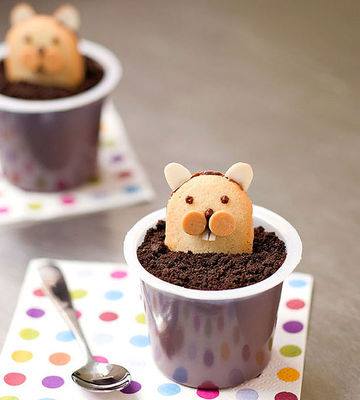
Happy Groundhog Day! But I didn't make a special dessert.

I've never actually made a special dessert for Groundhog Day.  Although I am very glad to hear that Punxsutawney Phil did not see his shadow and therefore predicts an early spring.  And I do like the Bill Murray movie Groundhog Day!


from FamilyFun magazine - these Punxsutawney Pudding Cups are pretty cute

A few years ago, I wrote the following for an essay published in a homeschooling magazine:
"We have a lot of traditions, those my husband and I have grown up with and those that we have created with our own children.  These traditions may involve just us or extended family; they may be related to seasonal changes or secular or religious holidays.  Our traditions nurture connectedness, whether it's reading the special card or wearing the silly crown I make for each birthday, baking and decorating cookies every Christmas with their cousins, or watching the movie Groundhog Day every February."  
I love traditions.  I even enjoy making special desserts for special occasions.  As I wrote above, participating in traditions with family, friends and others is a way to be connected with them and adds joy to our seasons and celebrations.  But traditions can threaten to lose their joy, I think, if we take them too seriously.  Speaking of which, I didn't send out Christmas cards in December.  It's the first year I haven't done so in at least seventeen years.  There was no particular reason.  I've managed to send out cards in years when I was much busier.  I even sent them out in 2010, the year when my dad died on December 23rd.  The truth is that I do enjoy sending out Christmas cards and receiving them too.  It just didn't happen this past year for whatever reason, and that's okay.

We also didn't carve pumpkins last Halloween.  When I say "we" didn't carve pumpkins, I'm being pretty generous.  My kids are conveniently grossed out by de-gutting pumpkins.  I don't mind it.  We all enjoy carving the pumpkins and roasting and eating the pumpkin seeds though.  But October was very busy.  Or maybe I'm putting less pressure on myself to keep up these traditions.  The kids are older.  I've gotten older too (it's true!) and more mellow.  Traditions are fun when we enjoy participating in them together, but can seem more like a chore if we feel they are just one more thing to cross off the "to do" list. 

That doesn't mean I've given up on Christmas cards or Jack O'Lanterns.  I'm sure I'll continue to carve pumpkins with my family, send out Christmas cards and make special desserts for special occasions.  But if we take a year off from our traditions, that's fine too.  Now, back to thinking about sweet treats.  February is here, and frosted heart cookies are right around the corner!

*****

This is definitely not a lifestyle blog about homemaking.  However, please indulge me as I include photos of some of the special treats we've made for holidays and birthdays over the years.


Tuesday, January 26, 2016

Seriously!? Sometimes not.

When I was a fifth grade teacher, many years ago, I fell flat on my butt in front of my students.  I had been sitting at my desk, and when I got up to move to the front of the classroom - I slid on some loose papers piled next to the desk and fell.  It was a classic slip-on-the-banana-peel scenario.  While I encouraged creativity and fun in the classroom, I also prided myself on classroom management and order.  As such, I was the benevolent but undisputed leader of our community of learners.  So when I crashed to the floor that day, all twenty-eight of those tween faces looked at me expectantly for a cue.  Recovering from the shock of the fall, I smiled, "I'm okay - you can laugh."  And with a collective sigh of relief, they burst into laughter.  I laughed at myself too.   


I love to remember that story.  It reminds me of a situation when I made a split-second decision to not take myself too seriously.  Because often I do take myself way too seriously and over-think things.  I know that this type of thinking limits me and was reminded of that recently.  I've been listening to Magic Lessons with Elizabeth Gilbert, a podcast series inspired by her book Big Magic.  In Episode #5 "Access Your Joy," Gilbert talks to a songwriter who is creatively stuck.  The songwriter is understandably grieving the death of her sister and finding it hard to return to her work.   The conversation comes around to the idea that the songwriter takes her work too seriously.  Gilbert says, "I think it's possible that you might have a little bit too much respect for music."  She adds that the songwriter might belong to a "category of people who cannot make art very freely because they have too much reverence for it." 

Maybe I'm in that category of people.  Maybe I have a little much too respect for writing.  As an avid reader, I've been inspired, moved, transported, entertained and informed by the written word in so many forms.  So I imagine the readers of my own words.  And I imagine that everything that I share or publish on my blog should be...finished or polished or important or unique or special.  I worry that someone will read what I write and say, "so what?" 

But so what if they say "so what?"  And when it comes down to it, I'm the one imposing the big expectations on myself by taking myself too seriously.  That doesn't mean I don't want to practice, critique, edit, learn from mistakes and improve.  But none of that will occur if I take things too seriously to begin and continue.  If we take ourselves too seriously - in our work, in our communities, in our relationships - we may prevent ourselves from moving forward.  When we take ourselves too seriously, we may prevent ourselves from connecting with others, like I did with my students when we laughed together all those years ago.

We have to be willing to fall. 
To slip on the banana peel. 
To get up again. 
To move forward.   
And sometimes to laugh at ourselves along the way.