This word cloud was generated from my blog's home page using Wordle.
On June 18th, 2014, I posted on this blog for the first time. I wrote: "This blog is my project and the next step on my path as a writer." Then I started a 30-day blog challenge beginning on June 23rd, with the stated purpose of creating accountability for my writing. I successfully completed the challenge with my thirtieth post on July 22nd. In that post, I wrote about how it felt to put myself out there, be vulnerable and share my work. The content of my 30-day blog challenge varied greatly, as I said it would - everything from a silly haiku or limerick to book reviews or longish philosophical musings. In one post, I admitted that my blog didn't have a central theme and called it a blog about nothing (and anything), but also wrote:
"When I think about what I do like to write about, there are some general themes: family life; education and lifelong learning; nature; writing, journaling and other types of creative expression; books and reading; my neighborhood and city. I like to tell stories and to inject some humor when I can."
This word cloud was generated from my post "a blog about nothing (and anything)."
My writing did relate to some of those themes during my 30-day blog challenge. I also told stories about myself and my family. My most popular post to date is "This Baby," which is about my oldest child's open heart surgery when he was two weeks old. Although I've journaled about that over the years, sitting down and writing about it for my blog helped me to put the experience in a form - sixteen years later - that really touched me and others.
This word cloud was generated from my "This Baby" post.
I guess my point is - my blog doesn't exactly have a theme, and that's okay. Maybe the point of my blog is to help me grow as a writer. I'm not looking to focus on one topic; I'm too curious and attention-challenged for that anyway! In addition to the topics already mentioned, I also like to read and write about personal growth topics. Who knows what else!?
My sincere and heartfelt thanks to those who have read this or any of my posts so far!
(And continue reading below to learn more about word clouds.)
*****
About word clouds:
Creating word clouds can be addicting - I'm warning you. (I had to stop myself from creating more and more word clouds for this post.) My daughter and I have used word clouds to create gifts, including inserts for handmade books, posters, and t-shirts (by printing word clouds on iron-on transfer paper). Word clouds are a great tool and/or form of expression for kids, adults, teachers, students, homeschoolers, writers, artists, business-owners and anyone looking for some creative fun. Word clouds can be generated from a website or you can manually enter a list of words about a certain theme or topic.
Wordle is fun, but more limited. A big drawback is that you can only either print your word cloud or save it to their public gallery. You can't save it to your computer. The only way to save it and edit it is to take a screen shot of it, which works okay.
Tagxedo is better in our opinion. First, it has a lot more options for formatting. You can even put your words into shapes, not just "clouds." And with Tagxedo, there are more options for saving, editing and manipulating your word clouds.
Started as a new year's post, was abandoned for a time,
ambled through philosophical thoughts, and ended with sad songs.
The start of a new year always excites me with the promise of new possibilities. At the same time, I was feeling a bit melancholy lately. Partly because I don't love winter and clearly remember last winter's long, cold and dark days. Partly because I was thinking about the various struggles going on locally and globally. "Melancholy" can mean "a gloomy state of mind," but also can mean "sober thoughtfulness; pensiveness." I do have a pensive (slightly brooding) side to myself. Just call me Melancholy Mary. I actually discovered Melancholy Mary when I was in seventh or eighth grade at Blessed Sacrament Grade School. In our religion workbook, there was a section about the four temperaments. I can't believe I remember this. The temperaments were represented by four characters: Choleric Cal, Melancholy Mary, Sanguine Sue, and Phlegmatic Phil. I don't remember anything else about those workbook pages or much about grade school at all, but I remember those names. Especially Melancholy Mary.
Is it very melancholy to think of life as a struggle? Merriam-Webster.com defines "struggle" (the verb) as "to try
very hard to do, achieve, or deal with something that is difficult or
that causes problems." Right now I know people who are struggling with their own or their loved one's serious illnesses or challenges, both mental and physical. Others are suffering from income loss or other financial hardships. Relationships with spouses, children, parents or friends change or falter. Grief is ongoing for those who have experienced the death of a loved one. Change, and the struggle to adjust to change, is ever present. Often life does not turn out quite the way we expected. Beyond our personal struggles, there are the bigger struggles of our world. Violence, poverty, tragedies. I don't think it's pessimistic to think of life as a struggle. I truly believe that Life is Sweet, as I've written. Yet, despite what our conditioning or culture may tell us, when we recognize our struggles, that's when we can really connect. Why do people think it's better to not talk about our struggles? It makes them feel uncomfortable, so they
want challenges and emotions to be hidden. Or they want to
offer solutions or advice rather than simply listen. Or they think
talking about things will make the situation worse. When, really, just talking and being acknowledged can sometimes be exactly what we need.
When I was a youngish mother of three children ages five and under, I was talking to another mom who also had three children, just a bit older than mine. I truly loved mostly everything about pregnancy, nursing, babies and small children, but it wasn't always easy. I don't remember exactly what the other mom and I were talking about - maybe the sleeplessness, the physicality, or the constant needs. And she said, "It's hard." That's it - two simple words. She acknowledged the struggle. It didn't make me feel worse. It made me feel better and, not incidentally, more ready for the challenges. The fact that I remember this incident so many years later is a testament to the power of being able to share our struggles and have them acknowledged.
Which brings me back to the title of this post. "Sad songs, they say so much." Thanks, Elton John. I really love sad songs, and I'm not the only one. A Google search yielded an abundance of results about sad songs. Maybe we like sad songs because we feel like we're able to share someone's struggle or feel some solidarity with the singer or the song. It's a bit of a stretch, I know, but writing this post led me to sad songs. As I started thinking about sad songs and researching them online, I fell down a very deep rabbit hole. I read lists of sad songs, made my own list and watched a YouTube video of "Cat's in the Cradle." (I love that terribly sad song.) Then, I tried to find a certain sad song, remembering only the melody and the lyrics "goodbye, Michelle." I couldn't remember the chorus, but I was convinced that Don McLean sang it. After extensively researching Don McLean and still not finding my mystery song, I decided to listen to American Pie, which is clearly the longest song in the history of the world. Eventually, a random Google search found what I was looking for - "Seasons in the Sun," which was actually by Terry Jacks. Of course, then I had to search for the lyrics, listen to the song and also listen to more folk/rock music of the 1970s, most of which is also melancholy.
Through this entire process, all three of my children were swirling about me. Absorbed as I was in my research, I didn't realize it was almost 10:30pm. It was a weeknight. The eleven year old should have been in bed, and the teenagers should have either been in bed or studying. Yet there they were. And there I was: half-tuned into the music and the Wikipedia entries and half-tuned into the crazy threesome wrestling, dancing, fake-soccer playing, rough-housing, jumping on the couch.
And I heard:
"How do you dance to this music?"
"This is a Kermit the Frog song."
"I'm not wrestling, I'm pretending to get injured in soccer."
"Is this 80s music?"
"I know this song - Uncle Chris plays this song."
And I said:
"Maybe you sway, like this. Or clap."
"No."
"Stop wrestling!"
"This is waaaaay before the 80s."
"You should get ready for bed."
"Boys, are you done with your homework?"
And I thought: Seventies music has not caused them to flee to their rooms. I'm happy that my three teen/tween children still gravitate toward me, that we are here together in this room laughing and singing and dancing and wrestling, even if it is too late on a school night. I love these people, and I love this life. This beautiful-messy, happy-sad, joy-struggle of a thing called life...
And, so if anyone at all is reading this:
My wish for you, for this still nearly-new 2015,
is for a beautiful-messy, happy-sad, joy-struggle year of this thing called life!
*****
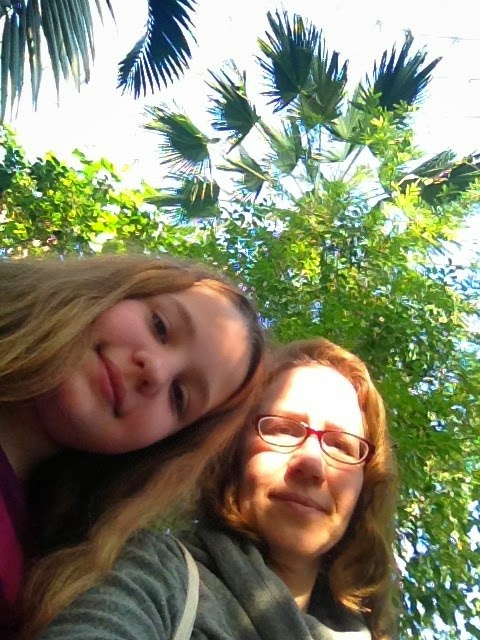
Melancholy Mary & daughter enjoy a sunny winter day inside the tropical dome @ Mitchell Park Conservatory.
Post-script:
I also like happy songs.
Love them, actually.
As the Muppets sing,
"Life's a happy song when there's someone by my side to sing along."
We need the happy songs and the sad songs, don't we?
Some of the sad songs on my list:
Cat's in the Cradle - Harry Chapin
Seasons in the Sun - Terry Jacks
Rocket Man - Elton John
I Guess That's Why They Call It the Blues - Elton John
Blowin' in the Wind - Peter, Paul & Mary
Leaving on a Jet Plane - John Denver
Everybody Hurts - R.E.M.
Redemption Song - Bob Marley
Here I Go Again On My Own - White Snake
Drive - The Cars
I haven't written monthly reading notes since September. This post covers the books I read from October through the end of the year. I hope to keep up with reading notes each month in 2015.
Novels:
Night's Child by Maureen Jennings Vices of My blood by Maureen Jennings
These two books are from the Murdoch Mystery series, which I've written about before.
The Things They Carried by Tim O'Brien
Not technically a novel, this is the classic collection of semi-autobiographical stories related to O'Brien's experiences as a young American soldier in Vietnam. I've never felt inclined to read this book, but my 16 year old son read part of it for a class and recommended it. You should read this book. A heartbreaking and important glimpse into a time and place in history.
May Contain Nuts: A Novel of Extreme Parenting
by John O'Farrell
I mistakenly thought that I was writing a satirical novel about modern-day parenting, and so I wanted to read one. Having already read Tom Perrotta's Little Children several years ago, I searched online for something else and came across this book by a British novelist. This over-the-top caricature of competitive parenting is pretty funny but tiresome at times.
The Woman in White by Wilkie Collins
I'm a huge fan of Victorian-era novels, but I had never read anything by Wilkie Collins. My friend Celeste suggested I start with this one. Good advice. I stayed up way too late a few nights in a row as I read this 600+ pages book compulsively. Loved it!
(Side-note: This is the first full-length book that I've read on a tablet. Reading a very long book in bed late at night, it was great to have it on the lightweight and bright iPad.)
*****
Nonfiction:
Mastering Showing and Telling in Your Fiction
by Marcy Kennedy
This is a short and good read with lots of helpful examples of how to improve storytelling in fiction. Now I just need to go back to some of my drafts and put the ideas into practice.
Zen Pencils: Cartoon Quotes from Inspirational Folks by Gavin Aung Than
I been following Gavin Aung Than's website Zen Pencils for a while now. Than adapts inspirational quotes into cartoon stories. When I heard that a compilation of his cartoons was coming out in book form, I immediately put it on hold at the library. My sixteen year old son read the book first, as a break from studying for finals. My other two children and I read it, too. We all agree - thumbs up!
Rebuilt: Awakening the Faithful, Reaching the Lost, and Making Church Matter
by Michael J. White and Tom Corcoran
I read this for a discussion with my church's Parish Council. We haven't had the discussion yet, but I'm looking forward to it. Although not entirely applicable to our parish, because it describes the experiences of a suburban church rather than our very urban church, it was an easy read and thought-provoking in ways.
Two additional nonfiction titles that I started but did not finish: How We Learn: The Surprising Truth About When, Where, and Why It Happens by Benedict Carey A Mind for Numbers: How to Excel at Math and Science by Barbara Oakley
I heard about both of these titles on NPR. Many of the books' ideas really overlapped, such as:
- self-testing on material you want to learn is more effective than highlighting or re-reading
- smaller amounts of spaced studying is more effective than a larger amount of time all at once
- studying the same material in different rooms or environments helps the material stick better
- discussions of how long and short term memory work
I love books about learning and how the brains works, but - unfortunately- I couldn't completely get into either of these.
The writers' styles just didn't click with me, or perhaps I didn't have
the concentration for nonfiction at the time I was reading them.
*****
Children 's novels that I read with or to my daughter:
The Cricket in Times Square by George Selden Tucker's Countryside by George Selden
I have previously read the classic, award-winning children's book The Cricket in Times Square.
I was inspired to read it again, to my youngest child, after we
observed some crickets on a nature walk. We also read Tucker's Countryside by the same author. These are heartwarming animal
stories with charming characters. Plus, you may learn a bit about music
and life in NYC circa 1960 (when the book was published) from The Cricket in Times Square. And the conservation message in Tucker's Countryside is even more timely today than when the book was published in 1969.
Chasing Vermeer by Blue Balliett
This
is a fun and intriguing mystery with some art history (and even math)
mixed in. It got my daughter and me a bit interested in Vermeer and very interested in pentominos. I'd like to read this book's two sequels, The Wright 3 and The Calder Game. Balliett has a pretty cool website, too.
Time Cat by Lloyd Alexander
This
book, published in 1963, is about a time-traveling cat. We thought it was okay, but not great. Who knew a cat preceded The Time Warp
Trio and The Magic Tree House in time-traveling adventures? Alexander is better known for his classic
children's fantasy series, The Chronicles of Prydain, which two of my children read and really enjoyed.
Mara, Daughter of the Nile by Eloise Jarvis McGraw
We loved this book. I hadn't heard of Eloise Jarvis McGraw until I was homeschooling my children. When studying Ancient Egypt, we read The Golden Goblet,
also by this author and also fantastic. Both are historical fiction
with some mystery mixed in. As with other "older" children's novels, you'll
find the language more sophisticated than children's novels of
today, but I think that's a good thing.
*****
Short stories:
I've read a number of short stories over the past few months. They are all pretty dark stories (except for "David's Haircut"). Some are stories that are referenced in The Storied Life of A.J. Fikry, a novel I wrote about in the summer. Others are stories that my sons read for English class. I'm listing them by author, alphabetically. I recommend them all and provide links to where you can read them online if you're interested.
Whew! That was a lot of reading to recap. This month I'm working on a couple of nonfiction titles, and I'm hoping to read another novel by Wilkie Collins.
It's hard to start doing something again that you haven't done for a while. For example, it's hard to start eating healthy breakfasts again when you convinced yourself that it was okay to eat Christmas cookies for breakfast over the holidays. Those were some sweet breakfasts! Thank goodness the cookies were gone before I completely outgrew my wardrobe. It was a close call.
These are not breakfast food.
Neither are these.
Also, it may be hard to start writing again after getting out of the habit. You will come up with a million ways to avoid it, if you're me. In fact, before writing this post I spent five minutes googling "back in the saddle," "back in the game," "it's hard to start doing things again," and other variations on these idioms or ideas. Excessive research is a common avoidance technique of mine. Of course, the only way to start doing something again is to do it. So, I'm back on oatmeal for breakfast. I started journaling again last week, and I'm posting to my blog today.
I haven't blogged since October 17, 2014. That's over eleven weeks ago. My last post was about National Novel Writing Month. I participated in NaNoWriMo 2014, but I did not "win" by reaching the official 50,000 word count. Still, I managed to write 22,000 words between November first and twentieth. Then I quit. I forced myself to keep at it for a while in the hopes that inspiration would come, but the truth is that I don't have a novel in me right now. I don't regret quitting NaNoWriMo. What I do regret is that I gave up writing altogether for the rest of the calendar year. I didn't write in my journals, nor did I write a single blog post. And the longer I didn't do it, the harder it became to start up again.
I completely dropped the habit of writing, a habit that is very good for me by the way. Writing, along with exercising, flossing my teeth, and reading (as a few examples) are good habits that keep me healthy or happy or both. I'm fortunate to have an exercise partner, which keeps me on track with that habit. Flossing my teeth is something I started forcing myself to do on a nightly basis several years ago. (If you know me, you know that I'm a little bit afraid of going to the dentist and that's part of my motivation.) Now flossing is part of my nighttime routine, and I very rarely skip it. I love reading, so I'm not inclined to avoid it. What about writing? I can see why I let blogging slide, because it sometimes feels "hard" to me. But I'm not sure why I let my journal writing slide. Maybe I didn't have an established system to keep my writing habit on track. For example, many writers write at the same time everyday no matter what.
Recently, I read an interesting blog post by James Clear about the difference between goals and systems, and it really made me think. Goals can stay in my head, but systems (or habits) are actions. I find this idea helpful in terms of aligning my actions to what I say is truly important to me, rather than just randomly moving from task to task while maintaining vague goals. When my children were smaller, I aimed for us to have a rhythm to our days. It was flexible, but it helped us all navigate our days. And then...seasons change, rhythms change, schedules change, children grow older. Sometimes we adjust well to changes, other times not so much. Sometimes new routines are easily established, other times we flounder. With two children in high school this year and one still being homeschooled, I felt sort of scattered and pulled in different directions these past few months.
Perhaps this was more of a transition for me than I thought it would be. Maybe I took too much of a wait and see attitude about things. Oddly, I have also been feeling like I'm "on call" all the time. For example, sometimes I feel like I'm always doing housework. That's not true at all. But perhaps if I'm tossing in a load of laundry here and there, instead of having a system of sorts - then it does feel like I'm doing it all the time. I'm not talking about rigid systems here, but rather guidelines. I think we all - no matter our work/family/home situations - benefit from re-evaluating our daily habits and routines from time-to-time, particularly when we are in transition in some way. Otherwise, we may not be intentional about how we use our time. Often it's easier to choose the (seemingly) urgent (housework, checking e-mail, paperwork, etc.) over the important (whatever meaningful tasks help us reach our goals). I originally read about this idea many years ago in Stephen Covey's book The 7 Habits of Highly Effective People. Many have reiterated Covey's basic ideas. I found a nice distillation of this concept in an article written by Martha Beck for O, The Oprah Magazine. It's an idea worth revisiting.
So, at the start of 2015, I am committed to establishing systems that will help me use my time to do the things that are most important to me and my family. Have you thought about your own goals for 2015? How might you establish systems or habits that help you work toward those goals?
Now that we are halfway through October, it's time to think about November. And you know what that means? No, not turkey! It means novel-writing. Last November, for the first time, I participated in National Novel Writing Month (NaNoWriMo). My daughter, then ten years old, also participated in the Young Writers Program of NaNoWriMo.
According to its website:
National Novel Writing Month (NaNoWriMo) is a fun, seat-of-your-pants approach to creative writing. On November 1, participants begin working towards the goal of writing a 50,000-word novel by 11:59 PM on November 30.
Valuing enthusiasm, determination, and a deadline, NaNoWriMo is for anyone who has ever thought fleetingly about writing a novel.
NaNoWriMo started in 1999 with twenty-one participants. In 2013, its fifteenth year: 310,000 adult novelists and 89,500 young writers participated. Young writers ages 17 and under set their own word goals. Quite a few past NaNoWriMo participants have eventually published the novels they drafted during the event.
When I decided to do NaNoWriMo last year, I knew I wouldn't come up with anything remotely publishable. And I didn't. It was all about challenging myself in a new way as a writer. Writing a 50,000 word novel seemed a big goal. I didn't think about it too much, fortunately, or I might have backed out. Dividing 50,000 words by thirty days comes out to an average of 1,666.67 words per day. I tried to stay on track by writing about 1,700 words per day. Some days I didn't write at all; other days, I wrote more than double that amount. I honestly didn't have a clear idea of my novel's plot, except that it would be realistic, contemporary fiction. Although I enjoy reading fantasy and historical fiction, I didn't have any ambition to create a fantasy world or research a particular historical era.
Let's just say my first novel ended up being highly autobiographical. It's not actually about me, but the plot and characters overlap in many ways with experiences I have had. I just read my novel for the first time last week - almost a year later! It's not as bad as I thought. Sure, it's not exactly a cohesive and flowing novel. It's more a series of somewhat-related short stories and essays about the same characters. There's some good storytelling and some interesting
characters. NaNoWriMo gives a pretty loose description of what constitutes a novel for the purposes of the contest, and that allows for a lot creative license:
We define a novel as “a lengthy work of fiction.” Beyond that, we let
you decide whether what you’re writing falls under the heading of
“novel.” In short: If you believe you’re writing a novel, we believe
you’re writing a novel, too.
Participating in NaNoWriMo last year was a fun and fulfilling experience. My daughter and I both felt really accomplished to have completed the challenge. We encouraged and motivated each other to finish, and we're both doing it again this year. By the way, there is a whole NaNoWriMo community - both online and local groups that meet in person - if participants are looking for support or camaraderie. Throughout the month, participants also receive pep talks from a variety of published writers. To gear up for NaNoWriMo, I've been rereading those and reading other good stuff about writing.
This week, I read the Get Serious About Writing blog series by Lisa Rivero. I heard Rivero speak a couple of years ago, when she talked to a homeschool group about her children's historical novel Oscar's Gift, which I read with my children and highly recommend. The short posts in her writing series are thought-provoking and motivating. I especially love No More Excuses: Jane Austen's Writing Table. First of all - Jane Austen! I hope to visit Jane Austen's home and museum someday as Rivero did. Secondly, this post provides a good dose of perspective. I've written before about my procrastination when it comes to blogging and writing. Seeing Jane Austen's tiny writing table where she wrote her famous novels is a good reminder to get over my excuses and just write. Another blog I found recently is Warrior Writers by author Kristen Lamb. I've been reading her current posts and trying to catch up on back posts too. There's lots of good stuff there. And she's funny! Some of her recent posts deal with NaNoWriMo and have given me a lot to think about.
*****
If you've ever thought of trying your hand at novel-writing or participating in NaNoWriMo, I encourage you to give it a try! Or, if your aspirations reside elsewhere, see if you can find or create your own challenge to help you work toward your goals.
In my August reading notes, I wrote that about the "heaviness" of my various selections that month. In September, my reading was less heavy and more escapist. I finished reading the Divergent series by Veronica Roth. This is a series of three young adult novels in the now-popular dystopian fiction genre. The first book was exciting and compulsively readable, but as I predicted it went somewhat downhill from there. My daughter read the books at about the same time, and we both thought the second book was okay and the third book was a bit disappointing. I also read two more books from the Murdoch mysteries series by Maureen Jennings. The fourth book, Let Loose the Dogs, is my favorite in that series so far. Mixed in with those books, I reread Charlie and the Chocolate Factory. Here's the official list:
Divergent by Veronica Roth Insurgent by Veronica Roth Charlie and the Chocolate Factory by Roald Dahl Poor Tom is Cold (Murdoch Mysteries #3) by Maureen Jennings Let Loose the Dogs (Murdoch Mysteries #4) by Maureen Jennings Allegiant by Veronica Roth
My varied reading habits had me thinking about the different reasons for which we read. Recently, I've spotted various Facebook posts about the stress-relieving benefits of reading. I've always known that reading helped me with my own stress. The claims of reading as a stress-reliever seem to be mostly attributed to a research study done at the University of Sussex. In an article in The Telegraph, researcher and cognitive neuropsychologist Dr. David Lewis explains that he found reading was a more effective stress-reliever when compared with a variety of relaxation methods. In the article, Dr. Lewis is quoted as saying:
It really doesn't matter what book you read, by losing yourself in a
thoroughly engrossing book you can escape from the worries and stresses
of the everyday world and spend a while exploring the domain of the
author's imagination.
This is more than merely a distraction but
an active engaging of the imagination as the words on the printed page
stimulate your creativity and cause you to enter what is essentially an
altered state of consciousness.
So then:
It makes sense to me. It also got me thinking about the idea of guilty pleasures. I remember reading an article not long ago that said - essentially - there's really no such thing as guilty pleasures when applied to our tastes in reading, music, theater and other forms of creative expression. I couldn't locate the article itself, but the author's point was: if you enjoy a particular genre, embrace it and don't feel guilty. Author Austin Kleon also writes about this in his book Show Your Work. The excerpt from his book, No More Guilty Pleasures, is posted on his blog. He makes several good points, including:
When you find things you genuinely enjoy, don’t let anyone else make you
feel bad about it. Don’t feel guilty about the pleasure you take in the
things you enjoy. Celebrate them.
Being open and honest about what you like is the best way to connect with people who like those things, too.
I was reminded of this when a friend joked on Facebook about her forays into historical chick lit as her own addiction, akin to alcohol, drugs or gambling. I'm a fan of historical chick lit myself. I even admit to an affection for regency romance mysteries, namely The Pink Carnation Series by Lauren Willig. Actually, I count as a pleasure (guilty or not), any series in which I can immerse myself. Many of us have jumped on the bandwagon to read popular children's or young adult series. I will admit that I once (maybe twice?) pre-ordered and had a newly-released Harry Potter book sent to a cottage in the north woods of Wisconsin, so that I would not have to wait until after vacation to read it. Talk about an addiction! But I've gotten caught up in all sorts of series. Once I zipped through the twenty books in the Aubrey-Maturin series of nautical historical novels by Patrick O'Brian in the space of several months. A couple of years ago, I read through the twenty or so novels in The Cadfael Chronicles, a series of historical murder mysteries by Ellis Peters. My obsessions tend to run toward to genres that contain historical elements.
We read for all different purposes. When I choose to delve into a series, I may be looking more toward entertainment and escape. When I choose a so-called classic or literary fiction, I may be looking more to challenge myself. And yet in both cases, there is a ton of crossover. A compelling and entertaining series of historical fiction, like the Aubrey-Maturin series, challenged me to learn a lot about the history of the British Royal Navy and the Napoleonic Wars. And of course, a book that is considered literary fiction or a classic can be as entertaining and addicting as a bestseller. This will all depend on the individual reader's tastes and inclinations as well.
What I discourage is the idea that we only read one type of book or another. I really believe that when this idea is imposed upon people or somehow accepted subconsciously, it may cause them to dislike reading. I wrote about this a bit in one of my articles for Home Education Magazine. In that article, I mentioned how some educational philosophies or theories maintain that children should be required to only read "quality" children's literature and be steered away from things like graphic novels and popular series books. With my own children, I have seen no evidence that it's one or the other. It doesn't have to be "either/or" - it can be "both/and." If, as an adult, I read different genres and for different purposes, why would I not respect my children's ability to do the same?
Lately I've been feeling overwhelmed. It's been a big transition having my two sons in high school this year. They both have SO much going on with copious amounts of schoolwork, sports and other activities, volunteer and church commitments, and very full social lives. We always seem to be running, running, running. And I always seem to be worrying, worrying, worrying. It's all relative, of course. I have three children. My own parents had seven. I met a man last weekend who grew up in a family of seventeen children. Seventeen children, people! Can you imagine? I can't - it's inconceivable. Yes, my busyness and my anxiety are relative. But that doesn't mean they aren't real. The way I feel is real. Every generation has their own challenges. Every individual has their own darkness and light. It doesn't help to discount any person's feelings or struggles. However, it is true that my problems are very much first world problems. For me, personally, gratitude and perspective are the tools that help me deal with my worries. I'm pretty sure most of us need doses of intentional gratitude and perspective from time to time. This morning, it was some pink-frosted chocolate cupcakes that jolted me with perspective and gratitude. Because the more I thought about those pretty little cupcakes, the more I thought about all the beauty and goodness in my life.
I thought about an e-mail that arrived this morning from a friend who noticed that I have talked about being overwhelmed lately and wondered if there was anything she could do to help. Then I thought about how another friend noticed that my running shoes had holes in them. She gave me the gift of store vouchers and cash, which enabled me to buy a new pair of shoes. Another friend magically always finds me exactly the things I need - an outfit for a special event, a winter jacket for my daughter, and much more than I can say here. Yesterday, I sat at the park with two other beautiful friends. We shared our joys and challenges. We listened to each other, we heard each other. This morning I noticed a chocolate bar in the cabinet. My husband often buys me a bar of European chocolate and sneaks it into the cabinet when he wants to cheer me. And also, this morning - those pretty little cupcakes. As I was busy doing some volunteer work on the computer - my daughter frosted those cupcakes. Life is sweet.
I am blessed and fortunate. I have a house, clothing, food, access to healthcare and education or educational resources, three healthy and happy children, a good husband, caring and compassionate family and friends. I am loved, and I love. Life is sweet, people, life is sweet.