Thursday, February 2, 2017

January reading notes - got privilege?

Two of the books that I read this past month had me thinking about privilege.  I have many privileges in my life.  I'm not saying any of these privileges are superior qualities.  Being born white and in the U.S. does not in any way make me better.  I'm also not saying that because of my privileges I have accomplished more.  Far from it!  People with fewer privileges have achieved much more.  Yet having these privileges has made my life easier in many ways.

Here are some of my privileges:
I am white.
I was born in the United States of America.
I was born healthy and have always had access to healthcare.
I grew up in a safe and cohesive neighborhood.
I had access to and attended good K-12 schools.
I graduated from college with a Bachelor's degree and a manageable amount of debt.
I grew up in a stable middle class family with two loving parents.
Through their strong example, my parents taught us to value: family, faith, education, community, hard work, civic and political engagement, service and volunteerism. 

All of those privileges or values I received by the fortune of my birth.  I recognize my privileges and am grateful for the values I was taught by my parents.  I also know that life is not a level playing field, and that many people start out with fewer privileges or none at all.  It doesn't take anything away from me to admit my white privilege or that I have a good work ethic due to my parents' example.  I don't feel that demeans me in anyway, so I don't understand why the idea of privilege is so controversial.  In my opinion, we need to recognize privilege in order to work toward overcoming many of the injustices in our society and our world. 


Evicted: Poverty and Profit in the American City by Matthew Desmond

I highly recommend this book to everyone I know.  It's the type of nonfiction that reads almost like a novel due to the compelling stories of the people portrayed and the author's process and excellent storytelling.  Matthew Desmond lived among the people he wrote about - both in a trailer park on the south side of Milwaukee and in an apartment on the north side.  I never realized how bad the housing situation is for Milwaukee's low income families.  People are spending more than half their income on housing and much of the "affordable housing" is run-down and dilapidated.  People have little recourse as complaints or questions to their landlords more often lead to eviction than to resolving the problem.  The people and families portrayed here have few of the privileges that I listed above for myself.  And at every turn, they are met with more roadblocks and challenges.  Desmond explains how eviction used to be a rare phenomenon in our country, and how it has now almost grown into an industry.  And he shows the ripple effect of all those evictions.  Just a few examples: kids change schools so often they fall far behind academically; frequent turnover in rental properties results in the lack of relationships and bonds that create strong neighborhoods; mothers who are struggling to keep their families from being homeless become despondent and depressed. 

The cyclical nature of poverty is very evident.  It will make you mad and sad to read this book.  Desmond offers some hopeful stories and ideas of how housing programs could be structured differently.  He also explains his fieldwork process at the end of the book, and it's pretty fascinating to read about it.  There is a website connected to Desmond's book that gives more information about the eviction crisis and resources to help.  You can find that at justshelter.org.  We cannot do embedded fieldwork like Matthew Desmond.  But how can we better accompany and advocate for those on the margins?  Whether that's through service work or dialogue or political engagement - it's a very important question.


Small Great Things by Jodi Picoult

Jodi Picoult is a prolific author known for writing books on a variety of social issues or current topics.  Her novels typically follow a formula with characters on two sides of an issue, a courtroom drama and a dramatic plot twist.  Small Great Things is a book about race and privilege.  It's a page-turner and a good novel.  The plot centers on a black labor and delivery nurse who is prohibited from caring for the newborn of a couple who are white supremacists, and what happens when the baby dies not longer after birth.  The book is told from the point of view of the nurse, her white lawyer and the skinhead dad.  The characters are interesting and the courtroom drama is compelling.  Of course, there is the question of whether the author - a white woman - can treat the subject adequately or fairly.  I think she does a pretty good job.  Her author's note explains her process and research.  I read a variety of reviews, and I found this one by Roxane Gay in the New York Times to be a fair assessment - the good and the bad - of how Picoult tackles the issue of race.   

For my own part, I would say - go ahead and read this novel about race.  And then also read books written by people of color.  Authors write from all sorts of experiences and identities outside of themselves - from the point of view of a different gender or time period or nationality or race.  But I firmly believe that if we want to learn more about the experience of black people, we should read books written by black people.  A few books I've read fairly recently and recommend: March (graphic novels) by John Lewis, The Underground Railroad by Colson Whitehead, Between the World and Me by Ta-Nehisi Coates and Americanah by Chimamanda Ngozi Adichie.  This year I'm planning to read books by Roxane Gay and Zadie Smith, two authors I've been wanting to read for a while.

*****

Also read in January:
Mockingbird by Kathryn Erskine
The Hound of the Baskervilles by Sir Arthur Conan Doyle


In progress or up next:
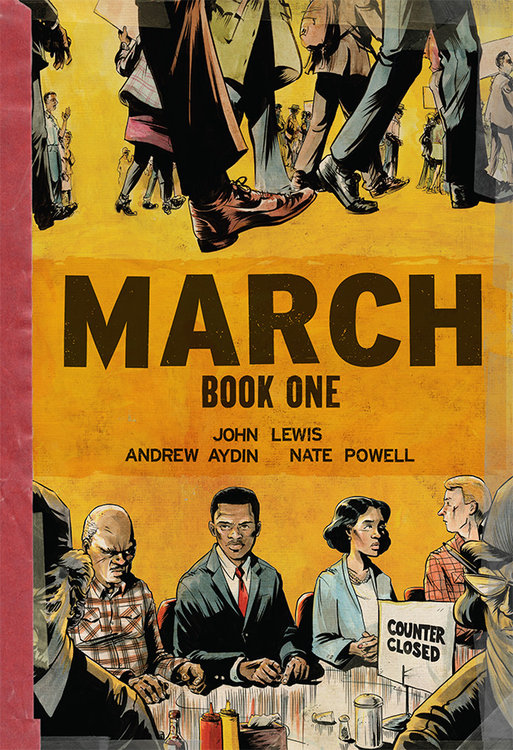

March Trilogy (graphics novels) by John Lewis, Andrew Aydin and Nate Powell (see more info here: http://www.topshelfcomix.com/march)
The Absolutely True Diary of a Part-Time Indian by Sherman Alexie

What have you been reading?

Friday, January 27, 2017

Visiting Oskar Schindler's Factory

On a cold bright day last March, my family and I arrived in the beautiful city of Krakow for a few days.  I had determined that tired and cranky teenagers would not prevent me from sitting at one of the outdoor cafes that surround the medieval market square to enjoy a refreshing glass of Polish beer.  Truth be told I was tired and cranky and sick myself.  Four of the five of us were sick with a cold that included a terrible sore throat.   Clouds and rain had dominated the weather since we arrived in Poland the previous week.  I was feeling somewhat melancholy.  But this trip wasn't a vacation or a tourist excursion.  It was a family visit with the main purpose of spending time with my husband's elderly parents.   

Ever the teacher, I’m always attempting to insert some "lessons" into our family travels.  Our last time in Krakow, which had been seven years ago, we spent a lot of time exploring the Wawel Castle and the Wieleckza Salt Mine.  We had no firm plans or agenda this time.  But I had thought we might visit the Auschwitz-Birkenau Memorial and Museum.  A couple of decades ago, I had visited Auschwitz with my husband.

In March of 2016, many of us already felt a great deal of unease about the rhetoric coming out of the presidential campaign.  Anti-immigrant stances, racism, islamophobia.  I didn't know then how bad it would get.  But I had this idea that we should take our kids to Auschwitz to witness this very dark and tragic part of our world's history – genocide - that is really so very recent.   

I have attempted to make history real for my kids.  In particular, I want to give them a sense of time.  All four of your grandparents were children during World War II.  By the time Auschwitz was liberated in 1945, they were about the ages you are right now.  Your Polish grandparents lived through the German occupation themselves. 

This isn't Ancient History.  I want them to know.  The history of the world is so vast, not even counting prehistoric times.  It's easy to look somewhat dispassionately at the brutality and violence of Ancient Rome, for example.  But this - the Holocaust - this was NOW. 

We didn't end up going to Auschwitz after all.  A fever and sore throat had kept me awake the previous night.  Rather than the full-day trip to Auschwitz, we decided to stay local.  We visited the Old Synagogue, which is now a museum, in the Kazmierz district of Krakow.  It is the oldest synagogue building still standing in Poland.  The museum focuses on the history and culture of Jews in Krakow. 

We also went to the Schindler factory, now a museum as well.  Like many people, I only became aware of Oskar Schindler through Steven Spielberg's movie Schindler's List.  The Old Synagogue and Oskar Schlindler's Factory are part of a network of history museums in Krakow.  The Schindler Factory is a very impressive museum.  It focuses on various aspects of the Nazi occupation of Krakow, with emphasis on the story of Schindler and the Jews he saved.  It’s overwhelming and inevitably disturbing.  We were there the week after Easter, when many people were on holiday throughout Europe.  The museum was crowded, and we were surrounded by people speaking Italian, Spanish, German, French.  Orthodox Jews, recognizable from their clothing, viewed the exhibits with tears streaming down their faces.


outside the factory/museum - a window of photos of those saved by Schindler

Our visit to the museum wiped us out physically and emotionally.  In retrospect, I realized that a full day of bus travel and visiting Auschwitz would have been too much, particularly for our youngest child. 

Oskar Schindler saved the lives of over 1,000 Jews during the Holocaust.  According to the website of the United States Holocaust Memorial Museum, the Jewish population in Krakow at the beginning of the war was between 50,000-70,000.  After the war, there were only about 4,000 Jews in Krakow.  Many emigrated, and the Jewish population in Krakow dwindled down to several hundred.  There has been a bit of a resurgence of Jewish culture in Krakow in recent years, with the Jewish Community Centre of Krakow serving as a hub. 

Six million Jews were murdered during the Holocaust.  Today is International Holocaust Remembrance Day and the 72nd anniversary of the liberation of Auschwitz.  This year, in particular, let’s remember.  As right-wing populist leaders and xenophobic rhetoric gain ground in Europe and here in the U.S., let’s be deliberate in remembering.  Never again.  Let’s look at others with compassion and acceptance for the humanity of ALL people regardless of religion or race or nationality.   


Old Synagogue, Krakow


Oskar Schindler's office

Friday, January 6, 2017

I pretend I am someplace else.


I pretend I am someplace else
where it is not 6 degrees and feels like negative 10
it smells fresh and mossy and alive
it feels light and warm and so close
it looks green and green and more green


I pretend I am someplace else
as I sit on a bench
banana trees clustered behind me
I gaze at the tree canopy
vines cascading down
a few random bursts of
orange-ish red and pale fuchsia
and variegated leaves
trees stretching themselves to the blue sky

I pretend I am someplace else
listening to the waterfall
crashing into the pond
I sit completely alone
for longer than expected
in this tropical dome
and bask in the solitude
gazing, observing, absorbing
scribbling these words
in my notebook

slowly, I start to hear voices
a family on an afternoon excursion
a young couple on a date
they appear from around
the winding pathway
grasping cameras
posing eagerly for photos
pointing excitedly at trees
reading the descriptive signs

I smile at them
gather my stuff and
move away from the bench
near the banana trees that
they wish to observe
They also want to be
someplace else
where it is not
6 degrees and feels like negative 10

I walk over to the pond
koi swim slowly
in shallow waters
a frog statue submerged
peacefully within
I take a few photos
I take a deep breath
and inhale the soft, moist air

Sharp, dry air
greets me as I exit
and return to
6 degrees but feels like negative 10
bolstered and grateful
for having been
someplace else
peaceful and warm.


This reflection and these photos happened at The Mitchell Park Domes, also known as The Mitchell Park Horticultural Observatory.  A favorite spot of mine, its future is sadly unknown due to structural issues.  There is more information on the Milwaukee County website page.  For my part, I see great value in having an indoor green space like this in our city.

The above photos are from the Tropical Dome.  Below are a few from the Desert Dome:


*****
Spending time in nature - wherever it is found - is important to me.  I've written often about my appreciation for nature and its therapeutic benefits.  
 
Have you read my essay in Orion Magazine?  A snapshot of the abundance of nature in my city neighborhood, it appeared in the January-February 2014 print issue and can be read online here: https://orionmagazine.org/place/milwaukee-wisconsin-7739/
 
You might also enjoy these blog posts:

Saturday, December 31, 2016

Year-end reading notes

Since I started my blog in June of 2014, I've tried to share my reading notes each month or every few months.  This year, I have not kept up with that at all.  I last posted about books in May: January through April reading notes: ten reflections on books & reading

Even though I keep a record at Goodreads, I wanted to "close out" the year by writing about my reading here on my blog as well.  Listed below are the books I read from May through the end of the year.  I've starred and written a brief comment for my favorite reads of the last several months.  I look forward to writing about books more regularly in 2017. 


Fiction
 

**Eligible: A Modern Retelling of Pride and Prejudice by Curtis Sittenfeld
This is definitely the most enjoyable novel I read this year.  I loved it!  Highly recommended for Jane Austen fans and anyone looking for a fun read.

The Mare by Mary Gaitskill

Where'd You Go, Bernadette? by Maria Semple

The Abbey: A Story of Discovery by James Martin

Prep by Curtis Sittenfeld

The Forgotten Garden by Kate Morton

Orphan Train by Christina Baker Kline

Knock, Murder, Knock! by Harriet Rutland

The Girl in the Spider's Web by David Lagercrantz

The Girl on the Train by Paula Hawkins

The Bean Trees by Barbara Kingsolver


**The Underground Railroad by Colson Whitehead
Definitely the best book I read in 2016.  Powerful and brilliantly-written.  Highly recommended!


**Commonwealth by Ann Patchett
An interesting reflection on families and family stories from an author I admire.


Nonfiction

A Deadly Wandering: A Tale of Tragedy and Redemption by Matt Richtel

Crash Course: Essays From Where Writing and Life Collide by Robin Black


**Revolution: The Year I Fell in Love and Went to Join the Sandinistas by Deb Unferth Olin
Having lived in Central America at about the same time as the author and having visited many of the same places, I really enjoyed reading this memoir. 

Taking the Leap: Freeing Ourselves from Old Habits and Fears by Pema Chodron

**Small Wonder by Barbara Kingsolver
I love Barbara Kingsolver's essays!  Enough said. 


**Maggie's Angels: Loving, Living With, and Learning from a Special Needs Daughter by John T. McCarthy
I know the author of the book, his wife and their delightful daughter Maggie, so I really enjoyed reading their story as well as the stories about other families navigating the challenges and joys of their loved ones with special needs.  An inspiring read.

Thirteen Things Mentally Strong People Don't Do: Take Back Your Power, Embrace Change, Face Your Fears and Train Your Brain for Happiness and Success by Amy Morin


Children's and Young Adult Fiction

Lyddie by Katherine Paterson

Feed by M.T. Anderson


**The House of the Scorpion by Nancy Farmer
A thought-provoking, creative and page-turning young adult novel about issues that are more relevant than ever - immigration, identity, science and ethics, the drug wars and more.  Highly recommended!

The Double Life of Pocahontas by Jean Fritz

Calico Bush by Rachel Field

Calico Captive by Elizabeth George Speare

The Skin I'm In by Sharon G. Flake

*****

Happy new year!


Friday, December 30, 2016

Minimalism revisited: out with the old...

At a Christmas celebration last week, a couple of cousins and I got to talking about decluttering and minimalism.  In February of 2015, I wrote the post Minimalist Mary says, "These boots were made for walking..."  about minimalism and getting rid of my seventeen-year-old boots.  Rereading the post nearly two years later, it still describes very well my attitude toward "stuff."  In fact, I'd say that I'm even more committed to the essence of the classic saying: "Use it up, wear it out, make it do or do without."  It's not just about minimalism, simplicity and financial priorities, but also about being aware of the finite resources and the precarious state of our beautiful planet.

living in WI, good boots are a smart investment

Back to those boots...  After getting rid of my seventeen-year-old boots, I "made do" with some hand-me-down boots for a while.  This winter, it became clear that the hand-me-downs were deteriorating and causing me some serious foot problems.  Finally, I bought new boots.  I'm not sure they'll last seventeen years, but I definitely know I'll wear them out.

 
In the last week or so - my husband, three children and I individually went through our own closets and dressers.  We all had clothing that we were no longer wearing, whether we outgrew it or just didn't need or use it anymore.  A few big boxes went to Goodwill.  I personally do not want to have more clothing than I can fit in my closet and dresser.  This is not only about minimalism and keeping clutter at bay, but it's also about the simplicity that results from not having a lot of clothes to choose from.  I've seen blog or Facebook posts in recent years about having a "uniform" or "go-to" outfit.  I grew up with school uniforms and wore them for first grade through my senior year of high school.  As much as I may have tried to push the limits of the accepted shade or style of shirt allowed with my uniform skirt in high school, I did recognize the benefit of not having to think about an entire outfit everyday. 

As an adult, I have my own uniform of sorts.  Black yoga pants and t-shirts or sweatshirts for around the house. Jeans and a couple of blouses or sweaters for going out with friends. Dress pants and a skirt that can be used with the blouses or sweaters for work events.  And then just rotate through those options.  People in many parts of the world live in small dwelling spaces and have no choice but to limit their amount of clothing.  They don't have extra bedrooms or walk-in closets.  Many people, myself included, find the limited possibilities of less clothing to be very freeing.  Less to chose from means less time spent on thinking about it and choosing.  Of course, if fashion is your thing - then minimalism in this area may not work for you. But there might be other areas in your life where minimalism and simplicity will benefit you. 

As I was having that conversation with my cousins last week, we all acknowledged how clutter in our living spaces could lead to clutter in our minds.  By living with less stuff, we free our time and mental energy to focus on what's important to us rather than on taking care of stuff.  Getting rid of physical stuff can also motivate us to get rid of mental "stuff" or shed habits that aren't serving us anymore. 

Heading into the new year, I'll continue to declutter.  As much as I love my books, the bookshelves could use some culling.  And I'm also going to think about mental "stuff" or attitudes and habits that I might want to let go of as well

How about you?    

*****
For a couple of more humorous takes on minimalism and fashion, see also:
Shopping is NOT a recreational activity
My top three accessories for middle age

Wednesday, December 28, 2016

in-between


I walk in the park
crunching on dirty snow
and wafer-thin delicate ice
encapsulating the fallen leaves
tissue-paper-thin
fragile remnants
of last season
faded shades of brown
frozen on the
black asphalt
beautiful shapes
winter's designs
randomly created
more beautiful than
any human-made
assemblage

breathing deep the cold air
I can't resist
these beautiful scenes
and must take photos
...or so I think
Before the phone,
I would just look
before the phone,
the in-between
contained more
more silent waiting
more daydreams
more sitting still
more nothingness maybe?

now it's swipe
and click and
check and check
read or skim
take pictures
of everything
the in-between
makes me restless
and uncomfortable
in a way that
it used to not be

but the leaves and ice
the overlapping beauty
of autumn and winter
remind me
the spaces in between
can be beautiful
if I can just wait
and see the beauty
in between
one holiday and the next
one season and the next
one year and the next
one stage of life and the next

once there were
small children
in my life
now there are
teens and young adults
on the cusp of everything
and so am I too really
change for all of us
waiting, waiting, waiting

for the next thing
impatient for it
but maybe, maybe
I could for a moment
stop thinking about
what comes next
I could be quiet
look and listen
appreciate life's
random designs
the series of events
and circumstances
some of them controllable
most of them not at all

and let go
waiting
appreciating
in-between


*****

Walking in Kern Park has inspired my writing before.  See also:

I hug the trees too.
See the trees


Tuesday, November 22, 2016

lost. and found.

I haven't blogged or written much at all these past few months.  I lost my voice.  In uncertainty and changes and insecurity and all-the-same-old-excuses.  Sometimes there are just so many thoughts and ideas.  They come to me when I'm falling asleep or taking a shower or driving.  I rehearse the ideas in my head, or I push them away.  I'll write that down later.  Yet over and over again, I don't write anything down.  Until it's hard to begin again.  But last Friday night, as I sat in a coffee shop, I wrote down these words.  It is a start.  I am finding my way back again. 


lost. and found.

the words have remained up there
jumbled together
in my head
now jumbled
on the page

we must write carefully
neat penmanship
sweet, quiet, docile
neat words
edited to perfection
carefully formed
to not offend

and yet why

rather
let the words
spill out
sloppy handwriting
smudged ink
and all

the notebook page
stained with
spilled coffee
as i wait
what am i
waiting for

this messy world
breaks my heart
at times
fills it up others
sometimes to overfull

keeping it all
contained
because...
we're not supposed to
"rock the boat"
disagree - resist
reveal - express

we're not supposed to
"get emotional"
which is what
they call it
when you
express an
opinion - view
experience - thought

stay quiet, nice?
NO. NO. NO.

I will not
I will not
stay quiet
I will not
worry about
what anyone thinks
or
worry about
making people
feel better about
who they are
or
what they believe

use your voice

I'll use mine.